Lantra Advanced Driving Assessment and Development | Airparks, Luton Airport
For professional drivers, holding the appropriate driving licence is only the starting point. Maintaining high standards of observation, vehicle control, hazard awareness and decision-making is essential, particularly when transporting passengers or operating larger commercial vehicles.
Beyond Driving has recently been delivering its Lantra Advanced Driving Assessment and Development course for Airparks at Luton Airport, working with drivers responsible for operating transfer buses between airport parking facilities and the terminal.
The training provides a practical example of how structured advanced driver assessments can help organisations develop their drivers, reinforce safe driving techniques and manage the risks associated with driving for work.

Advanced Driver Training for Airport Transfer Bus Operators
Airport transfer services present particular challenges for professional drivers. Operating larger passenger-carrying vehicles requires careful attention to road positioning, speed management, passenger comfort and the movement of other road users.
Drivers must also navigate a combination of busy airport access roads, junctions, roundabouts and surrounding public highways, often working to regular passenger collection and departure schedules.
At Luton Airport, Beyond Driving’s instructors have been working with Airparks drivers using the company’s own Volvo buses.
Using the vehicles that drivers operate during their normal working day makes the assessment directly relevant to their responsibilities. It allows instructors to evaluate driving techniques in a familiar vehicle while introducing improvements that can be applied immediately in the workplace.
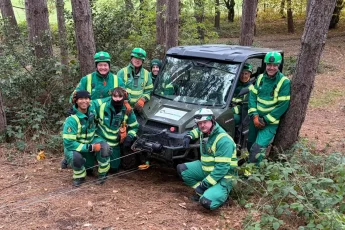
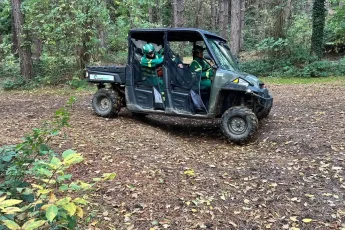
The accompanying photographs show the Airparks buses used during the training, including an in-cab view of a driver navigating a winding public road bordered by autumn woodland.
This practical on-road environment allows instructors to observe how drivers respond to changing road conditions, maintain appropriate positioning and manage their vehicles safely.
What Does an Advanced Driver Assessment Involve?
An advanced driver assessment goes beyond checking whether someone can operate a vehicle legally and competently.
It examines the driving behaviours, techniques and decision-making processes that contribute to safer, more consistent professional driving.
Beyond Driving’s assessment and development approach can address several important areas.
Observation and hazard anticipation
Professional drivers need to recognise potential hazards early and respond appropriately. This includes identifying developing situations involving other vehicles, pedestrians, cyclists and changing road conditions.
Vehicle positioning and control
Larger vehicles require careful positioning, particularly when negotiating bends, roundabouts, narrow roads and junctions. Advanced assessment helps drivers develop a greater understanding of the space required to manoeuvre safely.
Speed management and braking
Smooth acceleration, appropriate speed selection and progressive braking are particularly important when carrying passengers.
Developing these techniques can improve passenger comfort while helping to reduce unnecessary vehicle wear.
Defensive driving techniques
Defensive driving involves anticipating the actions of other road users, maintaining suitable safety margins and adapting driving behaviour to the prevailing conditions.
Professional driving behaviour
Advanced assessments also consider driver attitude, concentration, decision-making and the ability to maintain consistent standards throughout a journey.
For airport transfer operators such as Airparks, these skills are directly relevant to providing a safe and comfortable passenger service.

Why Advanced Driver Assessment Matters for Fleet Operators
Organisations employing professional drivers have responsibilities that extend beyond checking driving licences and vehicle maintenance records.
The Health and Safety Executive (HSE) requires employers to manage risks associated with driving for work. Its guidance specifically addresses driver competence, suitable training, risk assessment and the need to review training requirements periodically. HSE+1
Advanced driver assessment can form an important part of this wider approach to occupational road safety.
For fleet operators, the potential benefits include:
- Improved road safety: Identifying driving habits that may increase collision risk.
- Greater driver confidence: Providing constructive feedback and practical development opportunities.
- Reduced operating costs: Encouraging smoother driving that may reduce fuel consumption, tyre wear and vehicle maintenance requirements.
- Improved passenger comfort: Particularly relevant to bus, coach and passenger transport operations.
- Documented driver development: Supporting employers’ internal health and safety procedures and driver competence records.
- Consistent fleet standards: Helping organisations establish and maintain expectations across their driving workforce.
Importantly, advanced driver assessment should not be viewed simply as a test that drivers either pass or fail.
It is an opportunity to recognise existing skills, identify areas for development and provide practical guidance that supports continued improvement.
Developing Experienced Drivers, Not Just New Recruits
Even experienced professional drivers can benefit from periodic assessment.
Driving habits develop over time, and techniques that may once have been appropriate can benefit from review as vehicles, roads and operating environments change.
Advanced driver development is particularly valuable when organisations introduce new vehicles, expand their fleets or require employees to undertake different driving responsibilities.
For existing drivers, an assessment provides an independent evaluation of their current techniques, supported by constructive feedback from a qualified instructor.
For employers, it offers a structured way to identify training needs and demonstrate an ongoing commitment to maintaining driver competence.
The recent Airparks training at Luton Airport illustrates how this approach can be incorporated into the operation of an established passenger transport fleet.
Advanced Driver Assessment for All Vehicle Categories
Although the recent training involved airport transfer buses, Beyond Driving delivers professional driver assessment and development courses nationally across a wide range of vehicle categories.
These include company cars, vans, 4×4 vehicles, minibuses, buses, coaches, large goods vehicles and vehicle-and-trailer combinations.
Training can be tailored to the specific vehicle, operating environment and requirements of the organisation.
This is particularly important for businesses whose drivers work in specialist environments or operate vehicles that demand additional awareness and handling skills.
Beyond Driving’s instructors work with employers to provide relevant assessments and practical development, with accredited certification available through appropriate courses.
Training and assessment can support an organisation’s health and safety arrangements, although certification alone does not establish legal compliance. Employers must also maintain suitable risk assessments, policies and other necessary controls.
Nationwide Lantra Advanced Driving Assessment and Development
Beyond Driving provides professional driver training throughout the UK, working with organisations across transport, utilities, infrastructure, emergency services and other industries.
Our nationwide instructor network enables us to deliver assessments at employers’ premises, using the vehicles their drivers operate as part of their everyday duties.
Whether assessing individual employees or developing consistent driving standards across a larger fleet, we can tailor the programme to meet operational requirements.
The recent Lantra Advanced Driving Assessment and Development training for Airparks at Luton Airport demonstrates the value of investing in the continued development of professional drivers.
By combining practical on-road assessment with targeted instruction, organisations can help their drivers maintain the skills, awareness and professional standards required for safe, effective vehicle operation.
Book an Advanced Driver Assessment with Beyond Driving
If your organisation operates a fleet of cars, vans, buses, coaches or commercial vehicles, Beyond Driving can provide professional driver assessment and development training tailored to your requirements.
Our instructors deliver courses nationally, with Lantra-accredited options available to support your driver development and occupational road risk management programmes.
Find out more about our Driver Risk Assessment and Training courses or contact Beyond Driving on 01684 217152 to discuss your requirements.